HG Company Types - Hierarchy Overview
Last updated: December 5, 2025
Summary of Hierarchy Structure
HG Insights has developed a streamlined, four-tier company hierarchy system designed to provide a more accurate and operational view of complex organizational structures. This system helps sales and marketing teams better target decision-makers, understand true buying centers, and navigate complex corporate structures.
The Four-Tier Hierarchy
-
Global Headquarters (GHQ)
- The ultimate parent account in an organizational hierarchy
- Only one GHQ exists per organizational hierarchy
- Can span several distinct URLs
- Represents the highest level of the corporate structure
-
Corporate Parent (CP)
- The highest-level parent of all companies with the same normalized URL
- Independent businesses that operate within the GHQ
- Multiple Corporate Parents can exist under a single GHQ
- Provides visibility into distinct business units with separate operations
-
Domestic Parent (DP)
- The highest-level parent within each country for companies with the same normalized URL
- Country-specific entities of independent businesses
- Reveals regional buying centers and decision-making entities
- Particularly useful for viewing unique product deployments since HG attributes installations to companies via URL/country
-
Lower Level Entity
- All entities that fall below a Domestic Parent
- Subsidiaries, branches, and smaller organizational units
- Represents the most granular level of the hierarchy
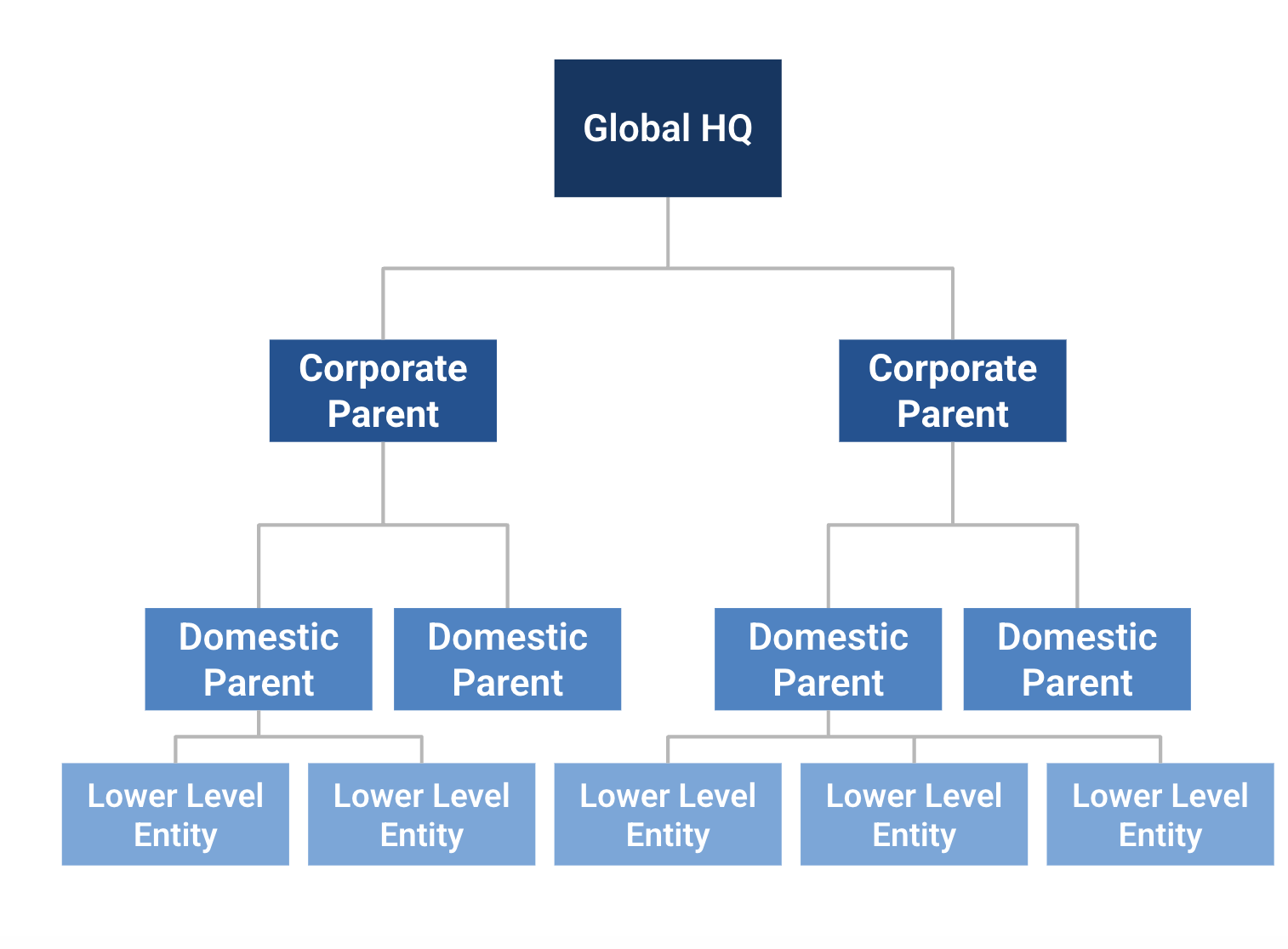 URL Normalization Approach
HG identifies and matches companies based on URL and normalized URL. This normalization process standardizes the many ways a company might format a URL. For example:
- advanceautoparts.com is recognized as the same company as shop.advanceautoparts.com
- This approach helps consolidate fragmented company data into a unified view
Benefits of HG's Hierarchy Structure
- Simplified Navigation: The four-tier structure makes it easier to understand and navigate complex corporate relationships
- Operational Focus: Reveals actual buying centers and decision-making entities within organizations
- Complete View: Consolidates multiple legal entities into a unified perspective of complex organizations
- Accurate Targeting: Helps identify and prioritize the right accounts within large enterprises
- Resource Optimization: Enables better allocation of sales and marketing resources
Using the Company Type Filter
When using HG's platform, the Company Type filter allows you to specify how broad your company sets should be:
- Global Headquarters (GHQ): Limits results to only the highest-level parent companies
- Corporate Parent: Includes the highest-level parents for each normalized URL
- Domestic Parent: Shows the highest-level parent in each country for a normalized URL
- All Entities: Returns results for all parent companies and their subsidiaries
This filter is particularly valuable for campaigns targeting specific organizational levels, such as global headquarters or parent companies within a specific region.
How HG's Hierarchy Differs from D&B
Fundamental Approach Differences
| Feature | D&B Approach | HG Approach | Key Difference |
| Highest Level Entity | Global Ultimate (GU) | Global Headquarters (GHQ) | HG allows only one GHQ per organizational hierarchy, while D&B's approach can result in multiple GUs for a single organization |
| Regional Entity | Domestic Ultimate (DU) | Domestic Parent (DP) | HG's DPs represent the highest-level parent within each country for companies with the same URL, eliminating the issue of multiple DUs within a single country |
| Hierarchy Structure | Complex with multiple layers | Simplified four-tier structure | HG offers a more navigable hierarchy focused on operational reality rather than legal structure |
| Data Completeness | Can be less complete with orphaned hierarchies | Market-leading completeness with consolidated view | HG consolidates what would be multiple disconnected hierarchies in D&B into a unified view |
Specific Improvements Over D&B
-
GHQ vs. GU Consolidation
- D&B's approach can result in orphaned or disconnected family trees, leading to multiple Global Ultimates (GUs) for a single organizational hierarchy
- HG consolidates what would be multiple GU hierarchies in D&B into a single GHQ, providing a more complete view of the organization
- This addresses the issue of orphaned entities and provides a unified view of a company's global operations
-
Domestic Parent vs. Domestic Ultimate
- D&B's Domestic Ultimates (DUs) are the highest-level parents within a single country, but there may be several within a single corporate tree
- This can result in missed connections between brands within the same country that belong to the same family tree
- HG's Domestic Parents (DPs) represent the highest-level parent within each country for companies with the same URL
- This gives a more accurate view of regional buying centers within a corporate hierarchy
-
Hierarchy Simplification
- D&B's hierarchies can be complex and difficult to navigate, with multiple layers and disconnected entities
- HG offers a simplified four-tier hierarchy that is easier to understand and use
- This simplified structure helps users focus on the most relevant parts of the hierarchy and optimize resource allocation
-
Data Accuracy and Completeness
- D&B's data can represent a single account as having multiple GUs when they should be a single GHQ
- HG aims for market-leading completeness with a focus on accuracy
- Firmographics are a core component of HG's IT spend model
- HG uses a rigorous process to clean and validate data and incorporates multiple data suppliers
By providing a more operational view of corporate structures that aligns with how businesses actually make purchasing decisions, HG's hierarchy system enables more effective go-to-market strategies and resource allocation.